

I’ve written several pieces on MTAR Technology — a company manufacturing various components and assemblies finding applications in clean-tech, aerospace & defence and nuclear power.
MTAR derives around 70% of their revenue from the clean-tech space, their most important customer being Bloom Energy, which contributes 55-65% of MTAR’s total revenue. The future of MTAR, is heavily linked with the future of Bloom Energy.
MTAR supplies 3 products to Bloom Energy viz. hot box assemblies, hydrogen boxes and electrolyzers.
So I got wondering — what exactly is it that Bloom Energy does? I started reading about the business, and I think I might have stumbled upon a company that can disrupt how power is generated, at scale.
I generally do not cover US stocks, but this one caught my attention!
Early beginnings
The main character of our story is Mr. K R Sridhar, the co-founder and CEO of Bloom Energy. Born in India, Sridhar saw an energy crisis unfold in India in the 1980s which is when Sridhar learned how to convert waste → ethanol to power an engine. It sparked his interest in the power sector.
Sridhar moved to the US to earn an M.S. in nuclear engineering + Ph.D. in mechanical engineering and then became a professor of aerospace and mechanical engineering at the University of Arizona for many years.
Soon he started rubbing shoulders with NASA and became a senior advisor to NASA in researching technology that could convert Mars’ atmospheric gases into oxygen for propulsion and life support.
In 2001, he co-founded Ion America with a mission to make clean, reliable energy. In 2006, the company’s name changed to Bloom Energy and in 2018, the company listed on the New York Stock Exchange (NYSE).
What does the company do?
Bloom Energy makes what is known as ‘solid oxide fuel cells’ or SOFCs. What makes SOFCs different, is that they produce electricity without combustion.
A SOFC consists of 3 parts — one solid ceramic electrolyte, a cathode and an anode. Air enters from one side (cathode) and a fuel [natural gas, biogas or hydrogen] enters from another side (anode). An electrochemical reaction produces steam (H2O), carbon di-oxide (CO2) and free electrons.
These free electrons flow through an external circuit back to the cathode, and voila, electricity is generated.
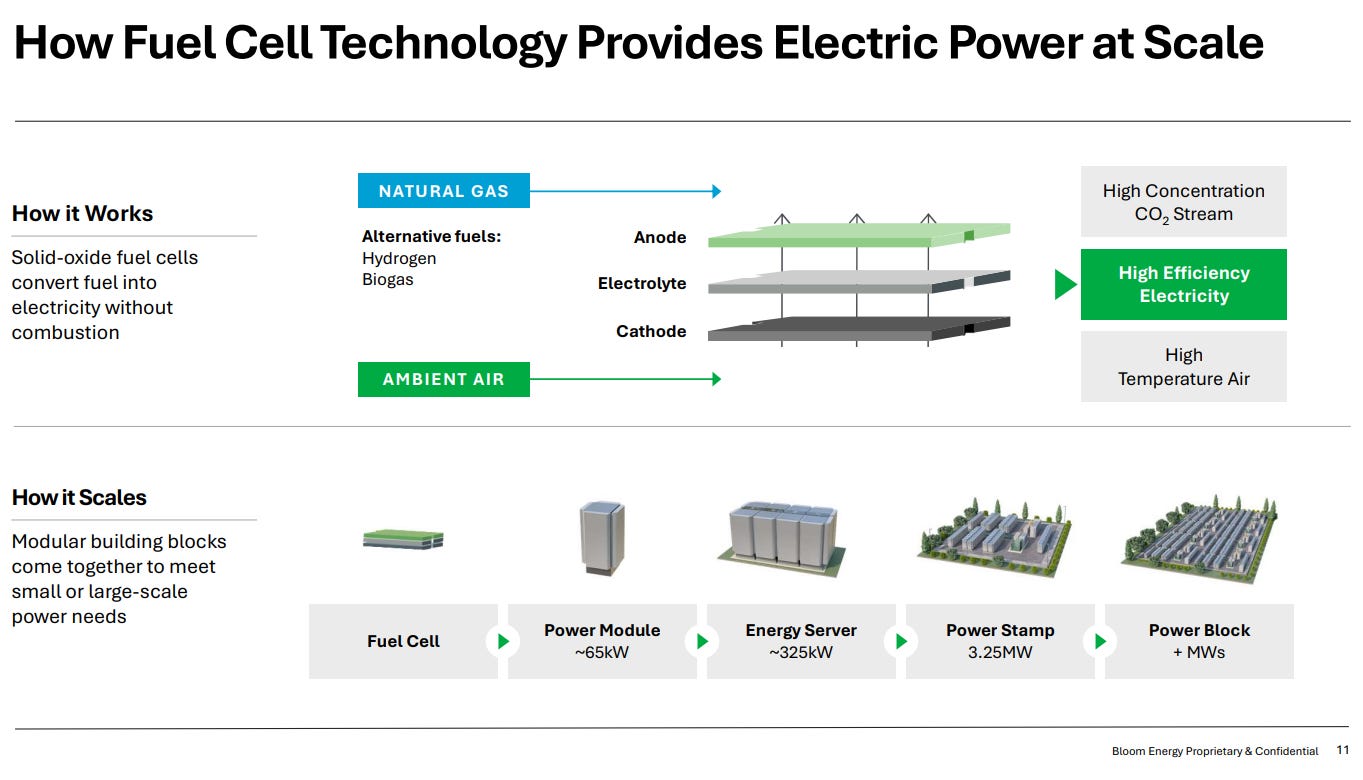
These cells are stacked on top of each other, and enclosed inside a hot box — which is known as a Bloom Energy ‘server’. Each server is roughly the size of a refrigerator and can produce around 200-300 kW of power.
What’s interesting is that these servers, are virtually zero emission with carbon capture systems integrated. They can be deployed quickly, use minimal water, and generate high efficiency electricity.
Bloom Energy servers achieve 60% electrical efficiency in converting fuel to power — significantly higher compared to gas engines or microturbines.
The fuel flexibility of Bloom’s design is a key advantage. The same unit which currently uses natural gas, can potentially switch to hydrogen in the future with minimal modifications.
The Power Revolution
Imagine you’re the CEO of any one of the hyper-scalers out there (AWS, Google Cloud, Azure, Oracle). You’re operating massive data centres, that are extremely power hungry. Your order book is swelling and you need to set up more data centres, to support massive AI growth.
Biggest blocker to scale the business? Access to power.
Your data centres need uninterrupted supply of electricity + a grid which can carry heavy workloads. A sudden spike in AI computing can destabilize power networks, since the transmission line that powers your data centre also powers millions of homes nearby.
So, you approach a power utility company to construct a transmission line exclusively for your data centres, but you need to wait 2-3 years before such a line becomes operational. Your competitors aren’t going to wait. They have found a way to scale without the need to connect with the public grid. How?
You speak with industry insiders, and find out your competitors are generating power ‘on-site’ using solid oxide fuel cells. No dependency on a public grid. A clean source of energy. The upfront costs are high but they don’t have to wait for a grid connection. Your competitors are able to get their data centres up and running in a matter of months.
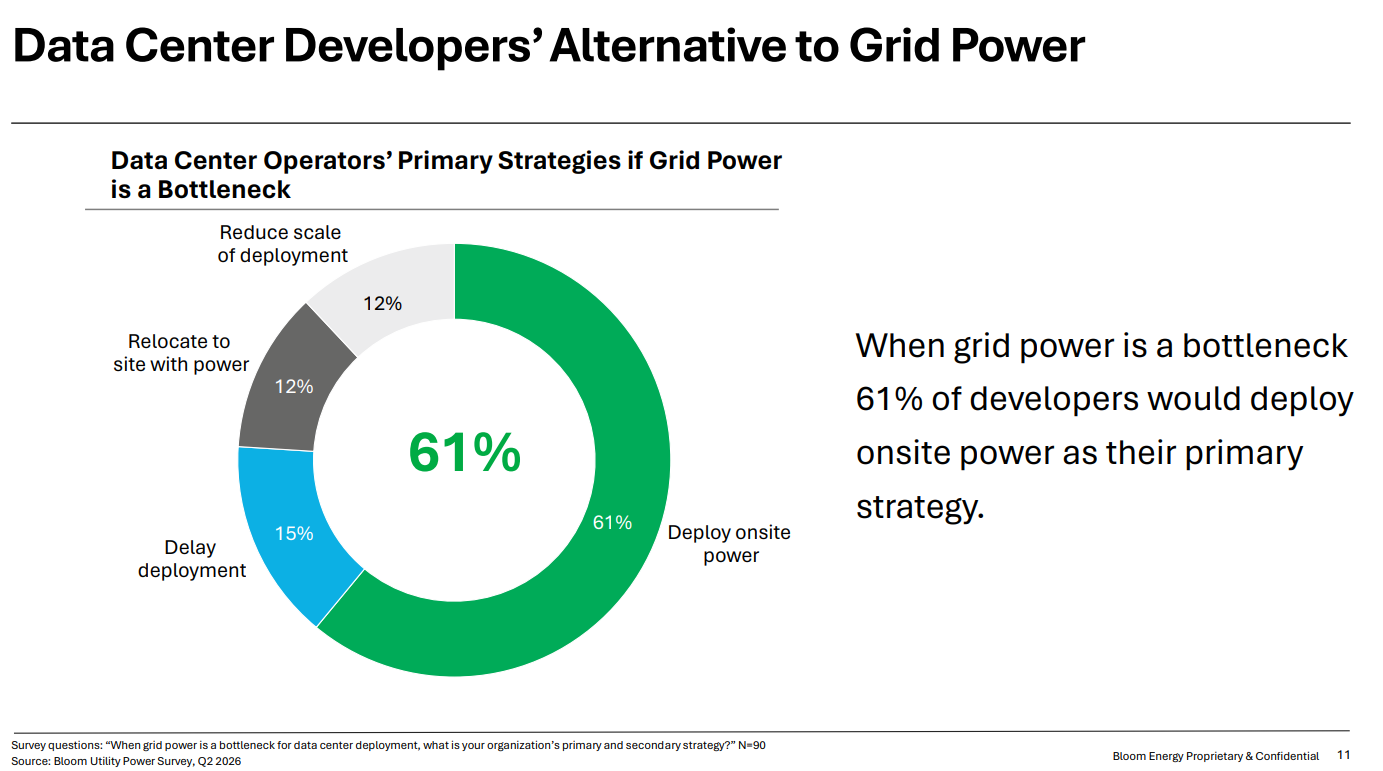
You are faced with two options — either you wait for a public utility connection and lose market share to your competitors OR you start generating ‘on-site’ power yourself. You definitely cannot lose market share, and so, you deploy power on-site.
The AI revolution is in turn causing a power revolution.
How does Bloom Energy make money?
More than 90% of revenue comes from product sales viz. Bloom Energy servers.
Once deployed, the fuel cells require ongoing maintenance + stack replacements, which Bloom covers in long term service contracts ranging from 10-15 years. Currently service revenue contributes only 6% to top-line, but as more servers get deployed, this should increase and adds a good layer of annual recurring revenue.
Bloom Energy also manufactures electrolyzers — which using similar solid oxide technology produce hydrogen from water using electricity. This is still in a pilot phase, but has a lot of growth potential as the demand for hydrogen grows.
Plus, the company is exploring an ‘Energy as a Service’ model where customers pay only for the power output rather than owning the SOFCs. This model could unlock a wider customer base.
Order book & recent deals
In one of the Q4FY25 investor reports, the management reported a product backlog of $6B.
The management didn’t reveal the latest order book in the Q2FY26 investor report — however if you look at the revenue booked for the first 6 months — that translates to $1.75B. So, my conservative estimate is that the order book should be at-least $4.25B.
In April 2026, Bloom Energy entered into a master services agreement under which Oracle will procure up to 2.8GW of Bloom’s fuel cell systems. This could be the first signal of how hyper-scalers are adapting to their growing power needs.
On June 30 2026, Bloom Energy announced the expansion of it’s strategic partnership with Brookfield — as Brookfield increases its framework to finance AI infrastructure projects increasing their outlay from $5B to $25B.
In this partnership, Brookfield will not directly buy fuel cells from Bloom Energy. Instead, Brookfield will serve as a financing partner to AI companies, hyper-scalers using its AI Infrastructure Fund.
For e.g. a big tech company that doesn’t want to strain their own balance sheet approaches Brookfield to help with its AI ecosystem buildout.
Brookfield will buy the physical assets (data centres, hardware etc) and lease it to the big tech company. At the same time, it will recommend Bloom Energy as the preferred power solutions provider — to provide off-grid reliable clean energy.
Revenue Guidance
This is where things get interesting. At the start of the year, the company gave a revenue guidance of $3.1-$3.3B for FY26. In the Q1 investor presentation, this target was raised to $3.4-$3.8B and in the Q2 investor presentation it was further raised to $3.9-4.2B.
The company also raised the margin guidance from 32% → 34%.
This is a clear signal that demand for Bloom’s fuel cells is real and rapidly growing.
What makes Bloom Energy a company to watch?
AI load is expected to drive a 47GW increase in data centre capacity by 2030 — a significant portion of which will require on-site power generation.
What puts Bloom Energy in a sweet spot, is that it can deploy its fuel cells extremely quickly. The company can deploy 50-100 MW of power in as little as 50-90 days. It claims it can deploy 1GW of power in 12-24 months.
A medium sized AI facility needs anywhere between 80-100MW of continuous power.
This ‘time to power’ is critical for AI companies because time is money. They cannot wait for the grid to come online, which could take years. And with Bloom, things can kickstart in as little as 3 months — which is a MASSIVE disruption in how power is distributed.
These fuel cells are clean. They release virtually zero emissions. Water usage is minimal. And, they produce more electricity per litre of fuel i.e. higher efficiency.
Yes, the upfront costs of installing these fuel cells are high but over the years management claims that they have brought the ‘total cost of ownership’ of this technology on par with traditional energy.
Under Section 48E of the Internal Revenue Code, fuel cell projects constructed after 31 December 2025 are eligible for a 30% tax credit. If you’re a buyer, this further brings down the cost of ownership of these fuel cells, making them more appealing.
Given how governments all over the world are trying to reduce the reliance on burning fossil fuels, any regulatory guideline tightening the grip on fossils will further increase demand for alternative sources of energy like Bloom’s fuel cells.
One of the things to watch — are commodity prices. Since these fuel cells operate on natural gas, any increase in the input prices of natural gas could adversely impact Bloom’s gross margins. I’m not sure whether Bloom can pass on the increase in natural gas prices to the final customer.
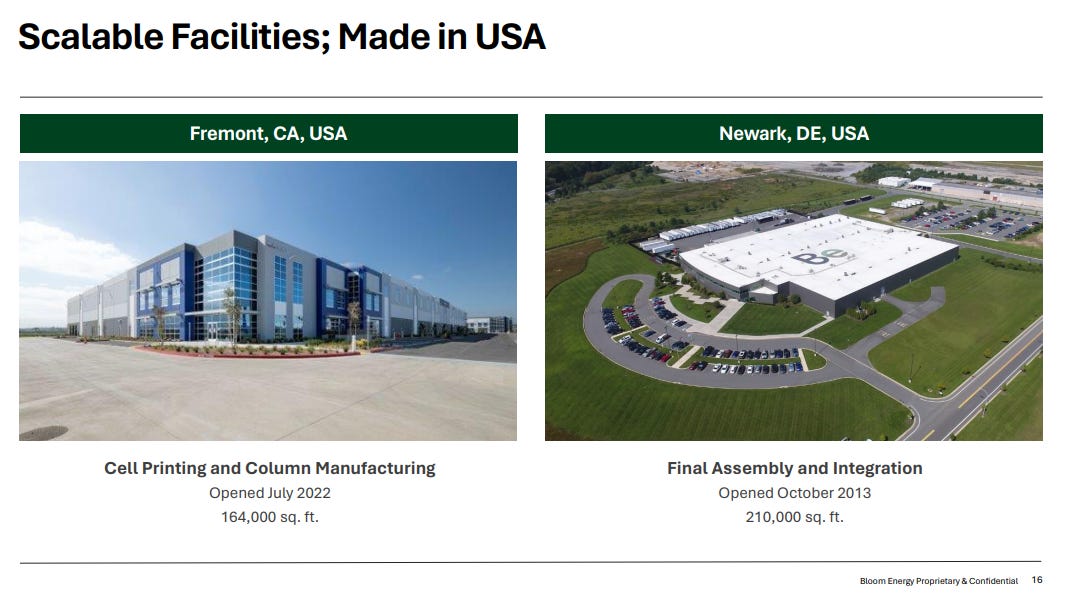
I’m a little hazy as to what is the exact manufacturing capacity of the company as on date, however the management claims that their current manufacturing facilities will allow them to deliver 5GW of product annually.
Everything is not as rosy as it seems..
My biggest concern with Bloom Energy, is its expensive valuation. The company is trading at a P/E of 270 times at a market cap of $60B — and the stock has already delivered a 4X return (approx.) in the last one year.
The market is pricing in a lot of optimism and with such cutting edge technologies — there’s a lot that can go wrong.
Further, as per the company’s Form 10-Q filing, 73% of all revenues was generated from a single customer (in the first six months of the year). Customer concentration is a big risk.
And then, there are many questions which remain unanswered. The investor PPT does a very basic job of giving you an overview of the business. Not much depth is offered in the investor con-calls begging answers to questions like:
What is the breakup of order book pipeline by customer and by end application? Why no order book details are shared as at 30th June? What is the execution timeline? How does the company have $14B in service order backlogs?
What is the CAPEX involved in every additional 1GW of capacity added? Is the company looking to build more capacity beyond 5GW? What is the current capacity utilization?
What is the export opportunity? Is the company bidding for international projects? What is the bidding pipeline? What is the hit ratio?
If you have read the SEC filings and have answers to the above questions, I would love to know, since I couldn’t fetch this information with my limited research.
Conclusion
I will be keeping a close watch on the company — and any company that increases its revenue guidance by $1B in a matter of 6 months deserves investor attention. Plus, Bloom Energy could emerge as one of the largest winners of the AI boom, at the same time disrupting how power is distributed in the world.
Disclosure: I had taken a very small position in the company a few months back, and will look to add more in case of a major correction from current levels.
Note: If you’re based in India, and you’re wondering how to invest in a US listed company — you have many options like IND Money, Vested etc. However, from a tax point of view an outward remittance exceeding INR 7 lakhs attracts a 20% TCS, which can be claimed while filing the annual ITR. Also, foreign securities need to be declared in your annual ITR. Consult a tax expert before you take a decision to invest abroad.
If you liked this article, share it in your investing network. Comment, like, show some love! I spend a lot of time in research & it would mean the world to me if you could recommend this blog to your friends.
[Note: The author is not a SEBI registered investment advisor and the contents of this article do NOT constitute investment advice. Always do your own research before you invest in a company]
Interesting story, still have to be wary of their input cost management. Also, investing from India is a pain, so hoping some Indian AMC buys it & we can get a more tax efficient exposure