

I started this blog with the purpose of increasing my knowledge of various businesses and continue my pursuit of finding multi-baggers. Every time I dissect a new business, I feel a sense of excitement, and that is what keeps me going.
Finding multi-baggers is a tricky thing. No one knows what’s going to happen in the future. You ingest all the publicly available information. You speak to insiders. You listen to podcasts, read blogs, forums and then your mind computes probabilities. Your entry point also dictates whether a stock becomes a multi-bagger for you.
What is the probability a company can increase it’s revenue, profits and market value by 10X? That’s a question I keep coming back to, when I am evaluating a business — and this is precisely why I am attracted to small-caps, where the probability is higher.
In this article, I am going to talk about the business of Elin Electronics — a small cap electronics manufacturer which is facing some serious headwinds in the business, the stock taking a [BIG] beating.
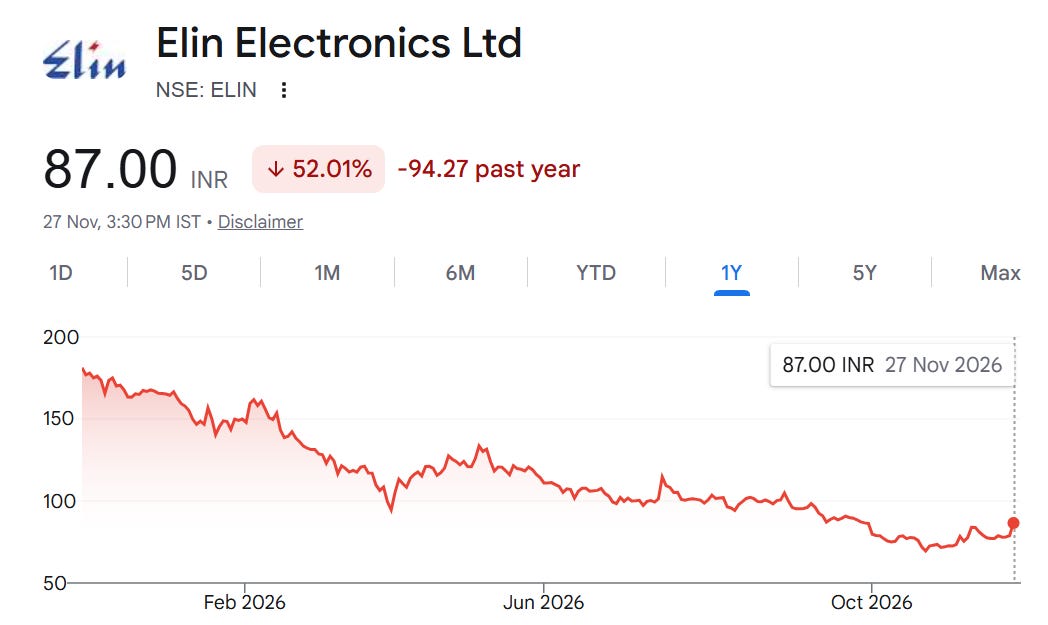
Whatever could go wrong for Elin, has gone wrong.
Raw material prices have gone haywire due to conflict in the Middle East region. Prices of plastic rose by 40-50% in selected categories (due to rising crude oil). Metals were up. Polymers were up 30% YoY. And a depreciating rupee didn’t help, affecting import cost of electronics and key components.
Add to that labour laws mandating minimum wage increase in Ghaziabad by 33% — where the company’s largest factory is located — leading to increase in employee costs. If all of that wasn’t enough, a fire broke in the Ghaziabad plant in May 2026, for which the company has created a provision of ~INR 25 Cr. The management expects to recover this loss via insurance claim.
Elin wasn’t able to pass all of the raw material price increase to their customer and had to absorb majority of it. It doesn’t have pricing power, yet. Despite being in the business for 50+ years.
Due to these factors, the EBITDA margin [already slim] reduced from 5.9% (June 2025) to 1.1% (June 2026) and the company posted a net loss of ~INR 21 Cr. A falling stock, kept falling, leaving no chance of a recovery.
So, you’d be wondering — why are we even talking about this company? There are clear structural weaknesses in the company. It is prone to raw material fluctuations and doesn’t have pricing power to pass on increase in cost to their customers. Not the stuff multi-baggers are made up of.
The primary reason is valuation.
The company is trading at a market capitalization of ~INR 430 Cr. The management is guiding for FY27 revenue of INR 1,400 Cr. If the company is able to achieve historic EBITDA margins of 7-8% in the future (FY28 and beyond), that translates to an EBITDA of INR 100 Cr. Not a remote possibility.

So what does Elin Electronics do?
In simple words, it is a contract manufacturer. The model is entirely B2B. A customer provides them with a design and Elin manufactures the product according to their specifications.
The company charges a service fee [EMS Fee] — to convert raw materials (also called bill of materials) into final products as per the customers’ specification.
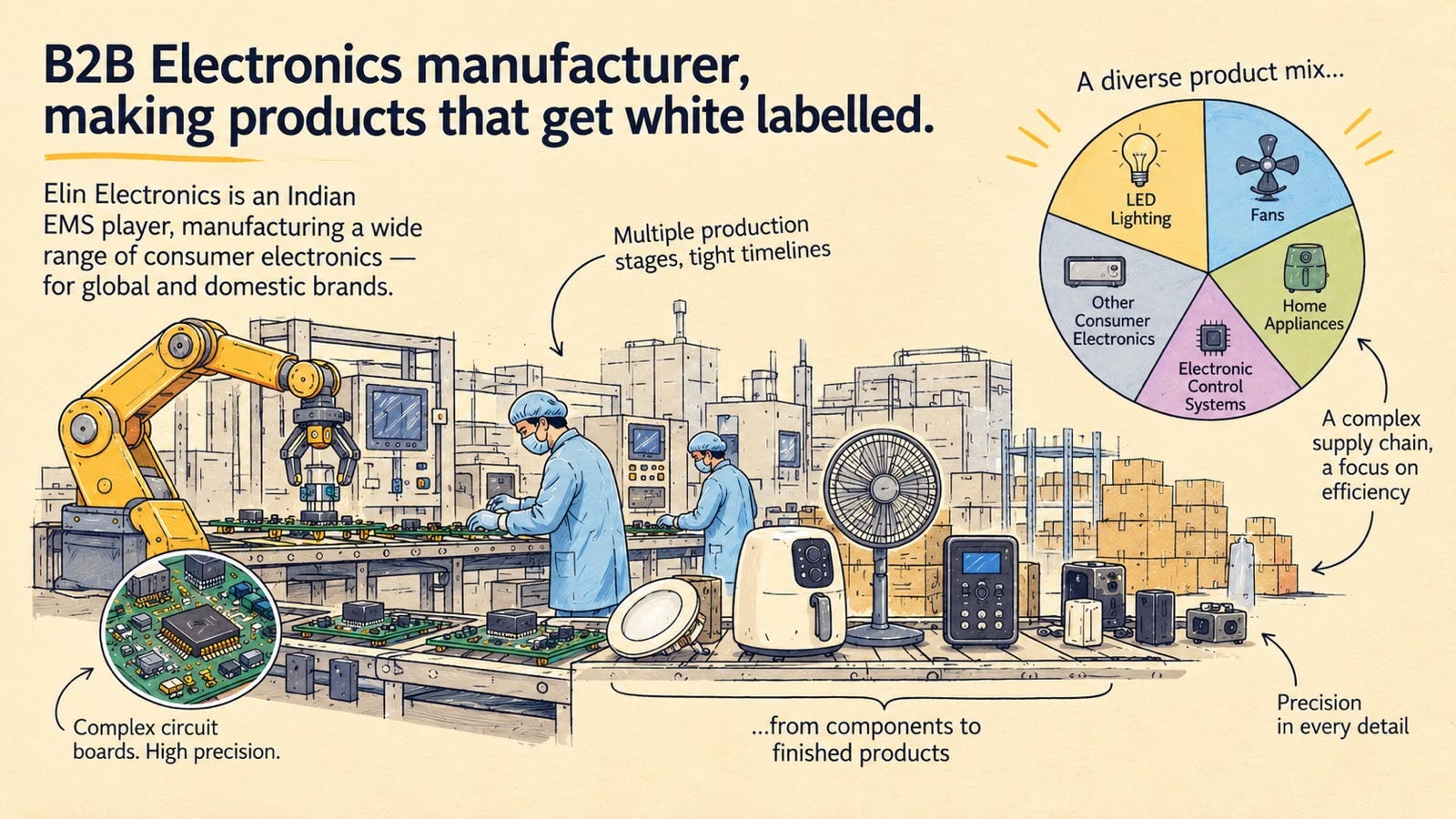
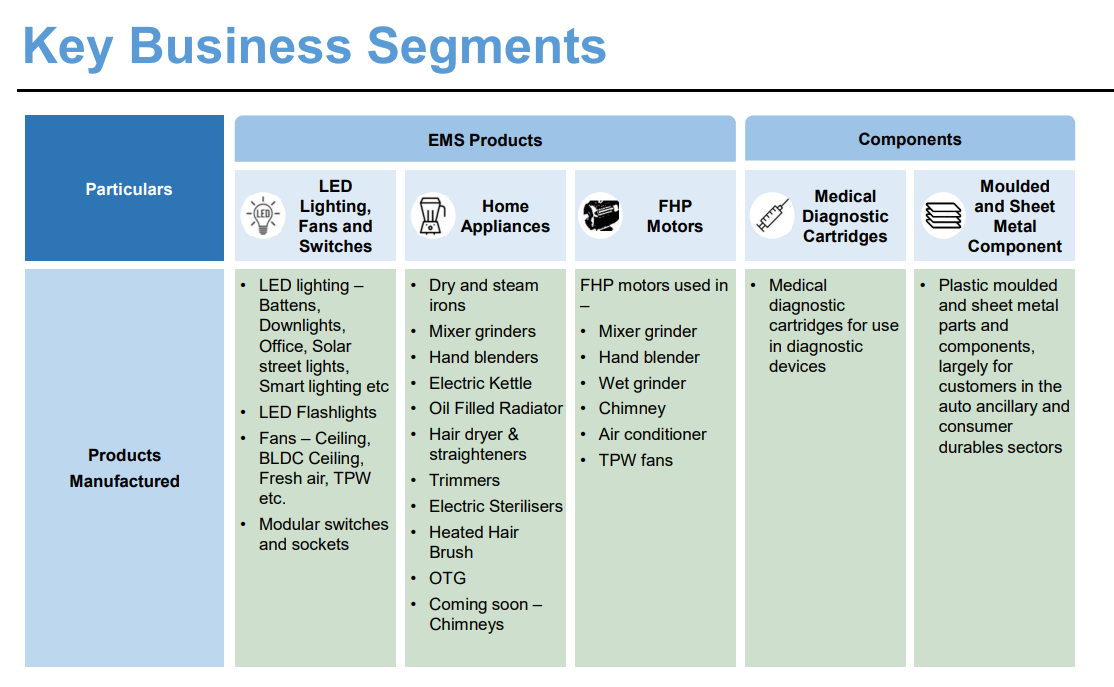
Elin manufactures electronics like LED lights, flashlights, fans, switches, home appliances, motors, medical cartridges among other things. The Company has 4 manufacturing facilities — with the 4th facility in Bhiwadi (Rajasthan) becoming operational in September 2026.
The management doesn’t disclose the capacity utilization of these facilities, however what I could deduce reading the earnings call transcripts — is that the management was not worried about revenue at all. They can increase top-line whenever they want. Which means they have enough spare capacity in their manufacturing facilities and that could translate into operating leverage in the future.
Margins, remain the highest bottleneck.
Given the abysmal reduction in EBITDA, I assume that Elin had entered into fixed price contracts with their customers. In which case, they carry the inventory risk.
If you look at Kaynes Technology — one the prominent EMS players in India — their EBITDA has not taken a hit despite all the hoolahoo going in the Middle East, which signals that Kaynes enters into a variable price contract, in which case it passes on any raw material increase to their customers.
Maybe that is one of the reasons why Elin exists in the first place. It offers favorable terms to its customers. And once you win a customer, and the cost of switching to another EMS player increases, that’s when you can start squeezing more margins out of your customers. I’d like to see if Elin is able to achieve that.

CAPEX - Bhiwadi Facility
Elin invested close to INR 70 Cr in ramping up their 4th manufacturing facility located in Bhiwadi, Rajasthan, with another INR 12-15 Cr of Capex planned in FY28.
The facility started commercial operations in Sep’26 of Oil Filed Radiators (OFRs) and will subsequently start production of chimneys + fans soon.
Revenue potential: The Company is expected to generate INR 90-100 in revenue from this facility in FY27, INR 150 Cr in FY28 with peak revenues of INR 550-600 Cr expected after FY30.
The company is guiding an EBITDA margin of 6.5% on the output generated from this factory in FY28. Very interesting. Something that needs to be tracked.
Green shoots
One positive is that the EBITDA margin of the Company improved in Q2FY27 from 1.1% (Q1) → 3.4% (Q2). This was due to stabilization of raw material prices to some extent + Elin passing on some of the cost to their customers.
Management has committed that their focus is on profitability going forward and they have scaled down the business of selling battens which was making a net loss, despite pushing up sales.
The Company is negotiating with existing customers to pass on the cost of increase in raw material prices + the assembly cost as well (due to the wage hike). If successful, EBITDA margins should inch upwards post FY28.
One thing I like, is despite going through a challenging time — the management has not stopped coming on the quarterly earnings call. They’re not hiding in their board rooms. They acknowledged their vulnerability and their inability to pass on cost escalations to their customers fully. They accepted that the stock has not delivered any meaningful return since the Company’s IPO.
The Sethia family (promoters) have enough skin in the game (33%+ shareholding) to figure out a way to change the fortunes of the company. Some of the family members are classified as non-promoters and if you include them the family holding exceeds 50%.
The Company has negligible debt, which is a MAJOR positive in a time when profitability is declining. Once you take on debt, you have to pay fixed finance cost, whether or not your business does well.
Bull vs Bear Case
The Bear Case is pretty simple. Raw material fluctuations continue to hamper margins. Majority of the customers don’t accept full cost pass-ons. EBITDA remains flat between 1-3% and the stock remains dead. ROCE below 10%. The management is better off putting all of their money in equity mutual funds which delivers (on average) a long term ROCE of 10-12%.
The Bull Case is a bet, that things would start improving drastically between FY28-FY30. A few customers accept complete material cost + assembly cost pass-ons. EBITDA inches up gradually from 3% → 6% → 8%. The Bhiwadi facility starts moving the needle. New high margin products are introduced. Elin is able to build pricing power with customers. The stock gets re-rated and zooms upward.
Where the scales of probability gravitate towards (bull or bear) would become visible in the next few quarters / years.
Conclusion
Elin has a market capitalization of INR 430 Cr as of today — it is effectively at rock bottom. I see very limited downside from current levels, unless another fire breaks at a facility OR a major corporate governance issue comes to light.
The investment thesis is simple. Elin negotiates for cost pass ons with clients. Focuses on profitability and introduces products with higher yields. EBITDA goes up. DIIs start buying the stock again and the company (finally) is able to create shareholder wealth. This thesis plays out in the next 3 years if execution goes as planned. Otherwise, the stock remains dead.
What to watch?
Can EBITDA margins stabilize between 4-5% in the short term and around 7-8% in the long term. This will signal whether contract negotiations with customers are succeeding.
Can the Bhiwadi factory generate top-line of INR 150 Cr in FY28 with an EBITDA of 6.5%.
The quantum of insurance claim received for the damage caused by the Ghaziabad factory fire + whether it is > 25 Cr.
Whether the mix of high margin products increase in the subsequent quarters + new product launches with higher margins.
Can it go from INR 430 Cr → INR 4,300 Cr in a span of 3-5 years? Only time will tell. All we can do, is roll the dice!
Disclaimer: I am an investor in this company, and I am accumulating at current levels.
If you liked this article, share it in your investing network. Comment, like, show some love! I spend a lot of time in research & it would mean the world to me if you could recommend this blog to your friends.
[Note: The author is not a SEBI registered investment advisor and the contents of this article do NOT constitute investment advice. Always do your own research before you invest in a company]